Many people ask me, are fox spirits gods or demons?
Before answering this question, I'd like to recount the events of that evening.
It was during a trip in the wilderness when, by chance, a fox peered out from the bushes.
That was a real fox—not a statue, nor a movie special effect. Its glossy fur shimmered in the moonlight, its form lithe and elegant. Its eyes held an indescribable intelligence, as if scrutinizing us, demanding food.
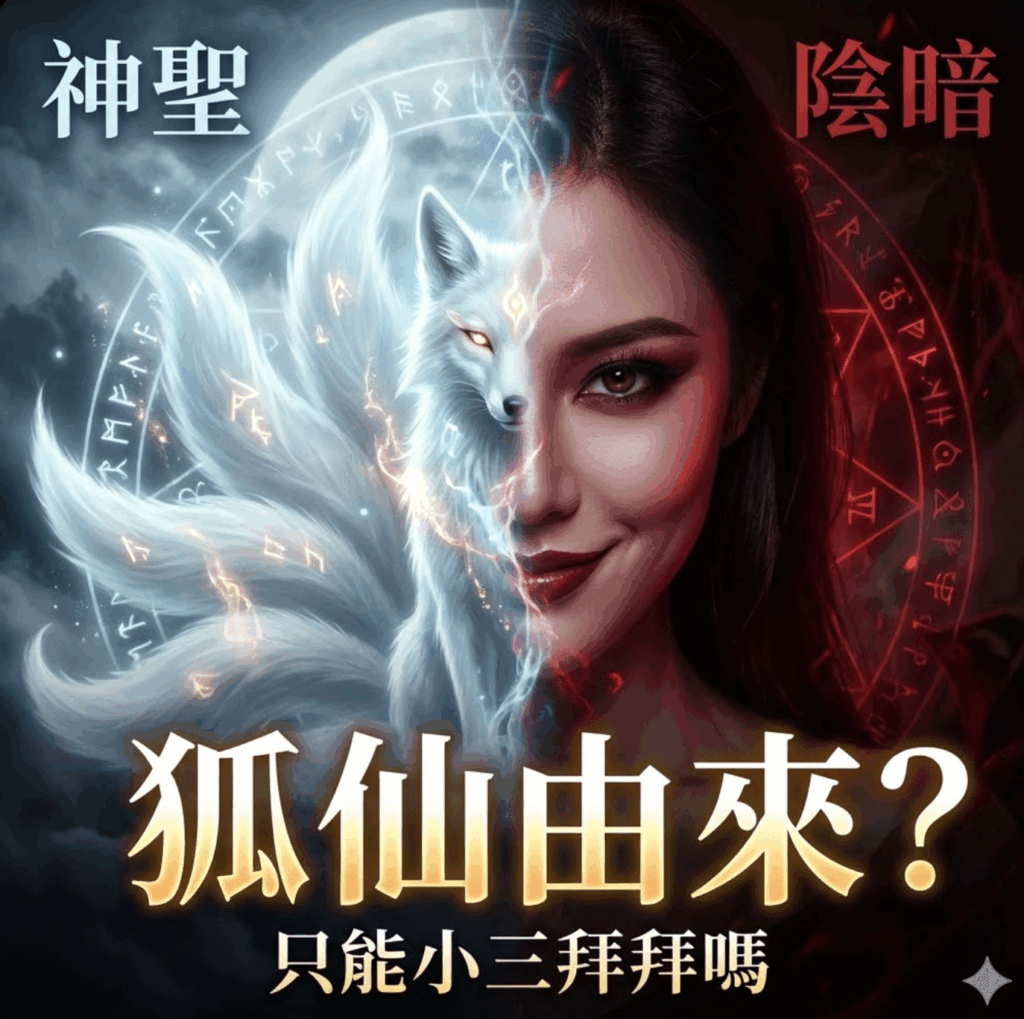
That very night, I had a dream. In it appeared a colossal nine-tailed fox, its entire body snow-white, the tips of its tails glowing with a violet light. The sheer awe-inspiring presence remains unforgettable to this day. It was in that very moment that I grasped the opportunity to master the fox spirit's mystical arts.
But this also made me begin to wonder: Why is it that such a beautiful and spiritual creature has elicited such polarizing opinions throughout human history?
I. The Stigmatized Goddess: From "Auspicious Sign" to "Fox Spirit"
If we peel back the layers of historical obscurity and probe the essence of the matter, you'll find that the public's current perception of fox spirits has actually been brainwashed by "fiction."
A niche yet authentic historical perspective holds that fox spirits were originally symbols of royalty and auspiciousness.
In the Classic of Mountains and Seas, the nine-tailed fox of the Qingqiu Kingdom was an entity of supreme nobility. When Yu the Great undertook his great flood control project, he married a nine-tailed fox from the Tushan clan to ensure the continuation of his bloodline. In that era of totem worship, foxes were revered as guardians of agricultural societies—legitimate "auspicious beasts"—because they preyed upon rodents that ravaged crops.
So when did the notion of "demonic allure" take root in popular perception?
The turning point may have come during the Tang Dynasty. Bai Juyi wrote "The Ancient Tomb Fox: A Caution Against Excessive Beauty" to satirize Bao Si, the concubine of King You of Zhou.
The fox demon in his writing:
The fox's guile through a female demon brings but shallow harm, Yet in the blink of an eye it blinds the eyes. The woman's allure through fox-like charm brings deep harm, Day after day, month after month, it drowns the heart.
This poem links "beauty" with "national ruin," forever burdening the fox with a heavy moral cross. Later, the Romance of the Gods further shaped Daji into the embodiment of a fox spirit, cementing the public belief that "wicked women = fox spirits."This is akin to modern readers treating Romance of the Three Kingdoms as historical fact while forgetting Records of the Three Kingdoms—we mistakenly conflate fiction with truth.
II. The Mirror Image of Modern Society: The Projection of Desire
Are deities or monsters merely projections of human desires?
In traditional Chinese social structures, the legitimate wife is often protected by official deities (such as the Queen Mother of the West and Mazu), symbolizing family stability and ethical values. But what about those women outside the system who yearn for love and power?
The fox spirit thus became the embodiment of this force.
In the public eye, she is the patron saint of mistresses, symbolizing destruction and temptation.
But in my view, the fox spirit represents the ancient concubine, or the modern woman who yearns to challenge fate and pursue freedom and autonomy.
This explains why many women working in the adult entertainment industry, KTV venues, or even the entertainment industry worship fox spirits.
Because they need to seek a force that straddles the line between good and evil to support them in an environment rife with competition and uncertainty. This isn't merely about seduction; it's about carving out a path to survival within the cracks of a patriarchal society.
Fox spirits have become the embodiment of "love's transcendence" and "self-realization" in their hearts.
III. When Desire Meets Magic
Returning to the supernatural perspective, fox spirits, though having attained immortality through cultivation, fundamentally originate from the animal realm. This means they remain closer to humanity's primal desires and are more inclined to intervene in worldly affairs to earn merit.
我曾運用狐仙法門幫助過一位女信徒。
At that time, she was extremely anxious, consumed solely by the desire for wealth, hoping the fox spirit would grant her overnight riches. As I studied her facial features, I sensed the aridity in her aura.
I took the opposite approach and told her, "You must seek love first; only then will wealth follow."
This sounds counterintuitive, doesn't it? The common logic is "money begets love," but the essence of the fox spirit's teachings lies in "allure" and "karma." Without activating your own magnetic field and interpersonal connections, wealth is like water without a source.
Fortunately, she took the advice to heart. Guided by the fox spirit, she didn't end up catching a wealthy husband, but instead met a young man who ran a pet shop.
Remarkably, perhaps due to her connection with the "animal spirit," after they came together, her energy felt replenished, and her career prospects rose accordingly.
Is the fox spirit the bold and passionate Nie Xiaoqian from Strange Tales from a Chinese Studio, or the treacherous Daji who brought ruin to the nation in Investiture of the Gods?
In truth, He is merely a mirror.
What you see as a demon is born from your desire to steal another's love; What you see as an immortal is born from your resolve to break free and live authentically.
So who can worship the fox spirit?
The lovesick, reckless for love.
In this day and age, when we label a woman as a "fox spirit," is it because she has truly done something wrong, or because we fear that uncontrollable power?
If you had the chance to make a wish upon a fox spirit, would you choose to conform to others' expectations or to love with reckless abandon?
Feel free to share your thoughts in the comments section.